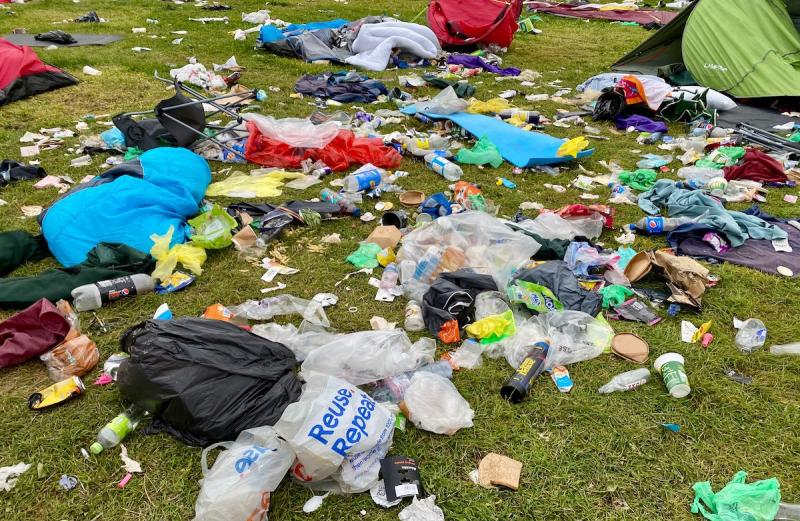
Leeds, England Festival Post Event Litter Hangover
Professor Joe Goldblatt
“Too much of a good thing …” is the age old maxim often used to describe extended periods of over indulgence. The primary purpose of festivals is to enter a liminal period where we escape from our daily predictable lives and explore, engage, and deeply experience time out of time.
However, in the post Covid 19 world, as our festival lives return to a new normal time, there has been a tendency to welcome unlimited growth as if we fear that if we do not seize this moment we might not have the opportunity to do so in the future. I am often reminded of the Roman bacchanalia and we know all too well what happened to Rome.
The 79th anniversary of the Edinburgh festivals may be one example of this unlimited growth. What began in 1947 with eight performing groups setting up temporary performing spaces in hotels and other non – traditional spaces to protest their exclusion from the original Edinburgh International Festival.
Since that time the Edinburgh Festival Fringe has grown to 4,200 performing groups who bring their work to Scotland’s capital city. In addition to the original Edinburgh Festival Fringe there are now over 300 Fringe festivals held annually in towns and cities throughout the world.
As the tents that once held dramatic circus acts for 25 days are lowered to the ground, there is an opportunity for reflection about how much growth is healthy for the sustainable development of all festivals.
A few years ago I delivered a talk about the opportunities to develop festivals related tourism in the USA state of Oregon. I carefully outlined and tried to make the case for all of the positive social, economic, and cultural impacts of local festivals.
At the end of my talk I asked if there were any questions and one person raised her hand and asked “What if we do not want any more festivals?” She then went on to explain that festivals also have negative impacts such as increased traffic, heightened prices for accommodation, greater accumulation of litter and many other negative outcomes.
I was surprised by her question because throughout my career I have been an international champion of well planned and efficiently managed festivals and events. However, her bold question provided me with a moment to pause and consider a view that was significantly different from my own.
The economist Adam Smith, a Scotsman whose Scottish enlightenment treatise entitled The Theory of Moral Sentiments sets out his ground breaking vision of how people judge right and wrong, rooted in “sympathy” — the ability to imaginatively share another’s feelings.
Through his view as an impartial spectator, he explores conscience, virtue, and the balance between self-interest and concern for others.
This book, published on New Year’s day of 1759, followed his defense of capitalism in The Wealth of Nations. In this first book he described the invisible hand of supply and demand that creates wealth among all nations of the earth.
Smith realised in his successor book that citizens have a moral and ethical responsibility to also show empathy for others by controlling our impulses. Therefore, as our major festival season comes to a close, perhaps this is the right time to take a deep breath and while remembering the joys of celebration to also reflect upon our responsibility in the post festival period so that future events are even more sustainable.
His general admonition was that in order for an enterprise to do well, it must first do good.
Following Mr. Smith’s philosophy, I believe there are three important questions we should ask ourselves and our festival stakeholders before planning future events.
Firstly, it is important to ask “How much is too much?” In other words is there a limit to festival growth within the destination where it occurs? What constitutes or signals the breaking or tipping point for festival growth? Are the early indicators greater and detrimental strains upon the social, cultural, economic, and environmental capital of the destination?
Second, at what point do we listen more empathetically to our adversaries who object to unbridled festival growth? How do we constructively engage with them to effectively demonstrate our willingness to consider their views and seek future collaboration for the good of our greater community.
Third and finally, how do we move forward in staging the growth of festivals to insure that they are economically, socially, culturally, and environmentally sustainable for as many people as humanly possible. After all, festivals are human endeavours planned by and delivered by human beings to hopefully advance human society in a multitude of positive ways. Could we adopt a slower and more steady approach to this development to insure we continue year after year to foster incremental growth that promotes the longer – term greater good for all citizens?
As the circus tent lower, the stages are disassembled, and the actors board their trains and planes to return home, I am very much grateful for the memory of this phenomenal enterprise that Adam Smith and other philosophers would have most certainly welcomed.
And at the same time, I am hoping that through a conscientious refocus upon this incremental expansion we may also express our moral sentiments for incremental and sustainable success for many years to come.
Professor Joe Goldblatt is Emeritus Professor of Planned Events at Queen Margaret University in Edinburgh, Scotland. His views are his own. For more information about his views visit www.joegoldblatt.scot