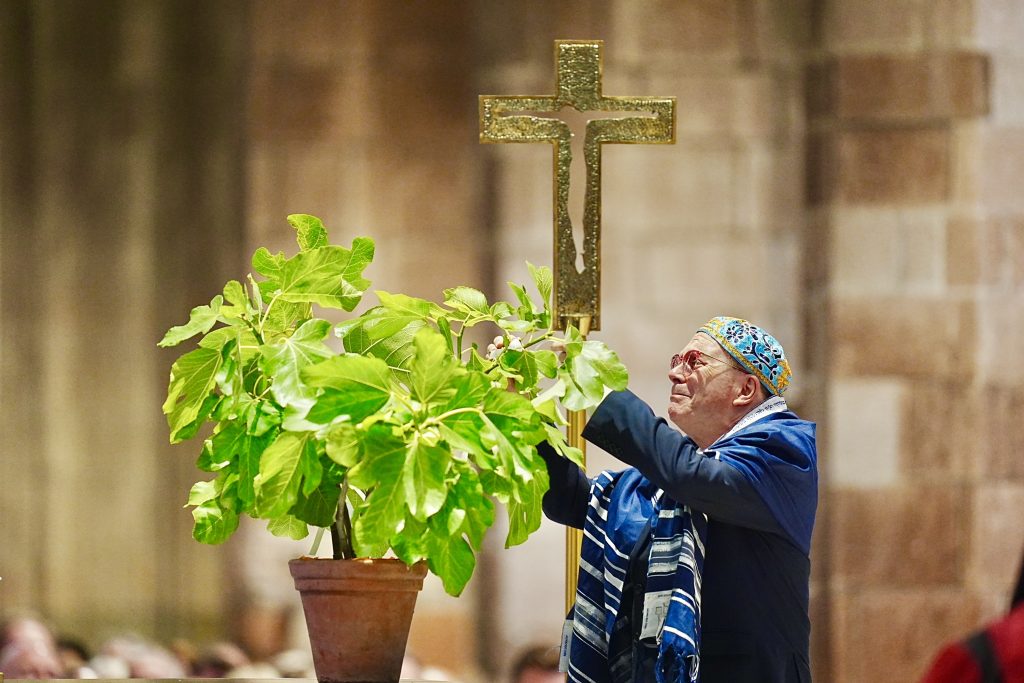
Ambassador for Interfaith in the City of Edinburgh, Professor Joe Goldblatt, ties a white ribbon to a fig tree at the altar during a service of remembrance commemorating the 25th anniversary of the 9/11 terrorist attacks at St Giles’ Cathedral in Edinburgh. Picture date: Friday September 11, 2026. PA Photo. Photo credit should read: Jane Barlow/PA Wire
Professor Joe Goldblatt
“I will be right back.” These were the words my dentist whispered to me as he stepped away from my chair to join his staff in watching their small office television. At that moment the first of the two World Trade Towers had been struck by an airplane hijacked by terrorists.
When the dentist returned to my chair he was ashen faced. We agreed it was better that I leave and I returned to my University office as I was the Dean of a large Business School at Johnson & Wales University in Providence, Rhode Island.
Upon arriving at my School I strolled the corridors to check on the welfare of my students and noticed that every classroom was watching in horror as the second tower was struck.
I immediately asked the faculty to suspend classes and invite all students to the cafeteria where we set up large television screens so they could view these fast moving scenes together and provide comfort for one another. I also notified the faculty and other members of staff to be ready to provide emotional support for students who needed help in coping with the tragedy unfolding only a few hours south of where we had gathered.
The University leaders soon decided to cease teaching and other activities and sent everyone home. I returned to my office and continued to monitor the situation in New York and now also in Washington, DC at the Pentagon as well as in Pennsylvania.
Immediately following this tragedy, a close friend of mine suddenly died in Texas. Her husband rang me and asked me to be a pallbearer at her funeral. I told him I was unsure whether any airplanes would be available for me to travel but that I would try my best to join him and his family.
Surprisingly, within a couple of days airplanes were once again in the air and I went to the airport to board my flight. The airport was eerily empty of all passengers and I walked directly to the gate and the somber and very sad flight attendant examined my ticket and allowed me to board the airplane. As I flew from Providence, Rhode Island to Dallas, Texas I did not know this, but aviation was about to change forever.
When I returned to the University the next day I was notified that one of my students was critically ill from an mysterious infection and was in intensive care at local hospital. I also learned that because he was from Morocco his parents and other family were forbidden by the US Government from entering the United States because their country was considered a destination that supported terrorism.
I immediately tried to use all of my previous extensive Washington, DC contacts up to and including the office of the US President George W Bush to make an exception and allow his parents to be at the bedside of their seriously ill son. Despite numerous calls and many compassionate friends in senior government roles, I was unsuccessful.
When my wife and I realised that my student, Mohammed, did not have any nearby family we began visiting the hospital daily. I spoke with his doctor and asked if he had exhausted every resource in trying to save Mohammed’s life. I even mentioned reaching out to other researchers in the field of infectious disease and the young doctor assure me that no stone would be left unturned.
A few days later the phone call I had been dreading came through to my office. The doctor explained that despite his best efforts Mohammed had died. He then asked me if I would like to come to the hospital to say goodbye to my student.
I immediately travelled to the hospital, held Mohammed’s hand, and recited the Jewish mourner’s prayer, the Kaddish.
I also realised that similar to the Jewish death tradition, Muslim funeral rituals must be immediately conducted. Therefore, I asked the leaders of the University for permission to contact Mohammed’s family and also a local Imam (Muslim religious leader) to arrange for his funeral rites and they fully agreed.
I explained to the Imam that I was Jewish and unaware of the Muslim burial rituals and would therefore need his help. He immediately put me in touch with a local funeral director who specialised in Muslim funerals and soon the Imam and close student friends of Mohammed went to the funeral home to perform the sacred washing and wrapping of his body.
At the conclusion of the funeral rituals in America his body was shipped home to his parents in Morocco by the funeral director. The cost to the University for this service was over $8000 US Dollars (£6000 UK Pound Sterling).
A few days later we conducted a memorial service for Mohammed at our School that was attended by the Imam and nearly 100 students, faculty, staff, and friends.
Several months later my secretary told me that a group of Muslim students wanted to meet with me.
One of the lessons I had learned after becoming a Dean was that if one student wished to meet with me it might be a generally pleasant encounter. However, if a group of students requested a meeting it might be tumultuous.
Therefore, I steeled myself for what might be a future battle as a group of four Muslim male students entered my office.
I asked them how things were going in the aftermath of September 11th and their sad faces spoke volumes. They were frightened, frustrated, and worried.
I then said “Although I am Jewish I want you to know that as the leader of this School your welfare is most important to me. If you experience any type of discrimination or threats of any kind, I want to be the first to know so I may help.”
They smiled slightly and then one student reached into his rucksack and removed a wrapped gift. He said “Dean Goldblatt, this is a small gift from the Muslim students of our School, During Mohammed’s illness we witnessed how you and your wife cared for our brother. You are now also our brother.”
When I opened the tissue paper wrapped gift I noticed it was a small mirror with a tiny photo of Mohammed attached. The students explained to me that in their tradition when I looked in the mirror I would forever see my former student and now eternal brother Mohammed as we would be joined together forever in love.
I was speechless. I sat in silence for some time and then the four Muslim men rose and we first shook hands and then embraced. Their act of kindness, compassion, and love would be cherished by me all the remaining days of my life.
Following the terrorist attacks of September 11, 2001 the world dramatically changed from stringent airport security to distrust of one another as evidenced by so many protests over immigration.
However, one thing also changed. My commitment to interfaith work grew stronger through the tragedy of losing Mohammed and the subsequent personal gift from my Muslim students.
Even greater than their small gift was the treasure of their friendship that day in my office as we all struggled to confront a world that had indeed changed forever.
Perhaps that is why a flood of memories poured forth this week when I tied a white ribbon upon the Fig tree, symbolising peace, in St Giles Cathedral. Despite all the changes in the world since September 11, 2001 I know that love and compassion is still possible and will continue to join others in working together for a more empathetic world as long as I live.
Post Script: Several months after the loss of Mohammed the Imam invited me to a reception that was raising money to build a new mosque in Providence, Rhode Island. Because of the negative feelings toward Muslims I asked several of my colleagues if they would be attending the reception. They all replied that “They had other plans.” I attended the reception and brought along a personal donation that I handed to the Iman. He thanked me and I said “This gift is in memory of Mohammed and in honour of my friend the Iman who helped me when I was in great need.” As Robert Burns said “We are brothers for all that.”
Professor Joe Goldblatt is Emeritus Professor of Planned Events at Queen Margaret University in Edinburgh, Scotland. He is also Ambassador for Interfaith Relations for the Edinburgh Interfaith Association. His views are his own. For more information his views visit www.joegoldblatt.scot