21st Century Voting: A Conundrum Threatening Democracy
Professor Joe Goldblatt
Upon becoming a dual citizen of both the United Kingdom and the United States I suddenly acquired the right to vote for political candidates in two countries. However, the process of voting in each country is I have come to discover as different as the phrase confirms “We are two countries separated by a single language.”
As a wee boy I recall accompanying my mother and father to our local primary school on the first Tuesday after the first Monday in November to watch them vote in the USA national elections. The first Tuesday convention was enshrined in the US Constitution to reflect the agrarian era so that citizens could have more time to, travel to vote at the end of their harvest season. The specific day of the week, Tuesday, was selected to avoid the Sabbath (Sunday) and allow more travel time.
The giant machine my mother used featured a dark blue privacy curtain, dozens of metal tabs, and a giant metal arm that she would thrust to her right after pulling down the tabs that recorded her voting preferences The tabs inserted holes in computer punch cards that would be sent to the central counting facility when the polls closed.
There was something magical and powerful in the smell of the large mechanical device, the whish of the curtain being closed to seal her private decision, and the loud thud of the arm being shifted to signify the vote had been casted. It sounded, smelled, and felt to me as if something important was being achieved.
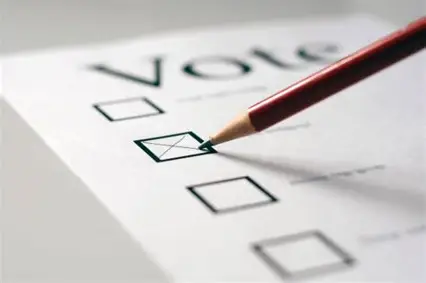
The first Scottish election I participated in was the 2014 Scottish independence referendum. I arrived at 6:30pm to cast my vote and to my surprise I was handed a paper ballot where I would affix my vote for or against the question as to whether Scotland should be an independent country. Similar to those many years ago when my mother thrust the handle to record her vote, there was something historically significant about using my writing instrument to record in a small box my X marking the spot of my democratic decision.
Later that evening I was appointed as an scrutineer to supervise the vote counters at The Royal Highland Show Ground at Ingliston where the millions of votes would be counted. I was cautioned not to distract the vote counters who sat quietly wearing green visors and counted our ballots. Although I could not interact with the vote counters, I was fascinated with their precision, concentration, and even good humour as they went about their tedious duties.
As I observed various neighbourhood’s votes being counted I could only imagine seeing the faces of friends who stayed in these areas and wondered how they could have made their voting decision given the complexities of the independence referendum. My emotions rose and and fell with each voting outcome. Indeed, I was observing democracy in action with all of its opportunities, flaws, and final outcomes.
In the USA national presidential elections of 2026 there has been much discussion about potential voter fraud due to postal ballots. As an overseas voter I was also concerned whether or not my postal ballot would reach its destination. Therefore, I was given a phone number in the USA to confirm my vote had been received and would be recorded.
Upon reaching the person in America who would confirm my vote I immediately realised that she was working from home as a contractor when I heard a baby crying loudly in the background which often interrupted our conversation. The voting official confirmed my name, my last address in the USA, and other details and then paused, clicked a few keys and said “Joe, I can confirm your ballot was received and will be counted.” As I heard her baby howl I also felt as though my vote counted not just for me but for this future wee bairn thousands of miles away.
I breathed a sigh of relief and then wondered why in the 21st century I had to actually telephone another country to confirm that my vote was received and would be counted. However, upon receiving this confirmation I felt a wee bit of the same pride of doing my duty that my mother may have felt all those many years ago when she stood behind the curtain and shifted the giant handle.
As voting becomes more complicated throughout the world due to fraudulent actors who seek to undermine democracy, according to historians the USA and the UK actually have among the safest and most secure voting systems in the world. Long may it last or as we Scots say “Lang may yer lums reek!” Whether you are shifting a handle or marking an X in a small box, it is important to participate in free and fair elections and in so doing our civic duty we are advancing democracy, one vote at a time.
Professor Joe Goldblatt is Emeritus Professor of Planned Events at Queen Margaret University in Edinburgh, Scotland. His view are his own. To learn more about his views visit www.joegoldblatt.scot