What is the Future of Parades?
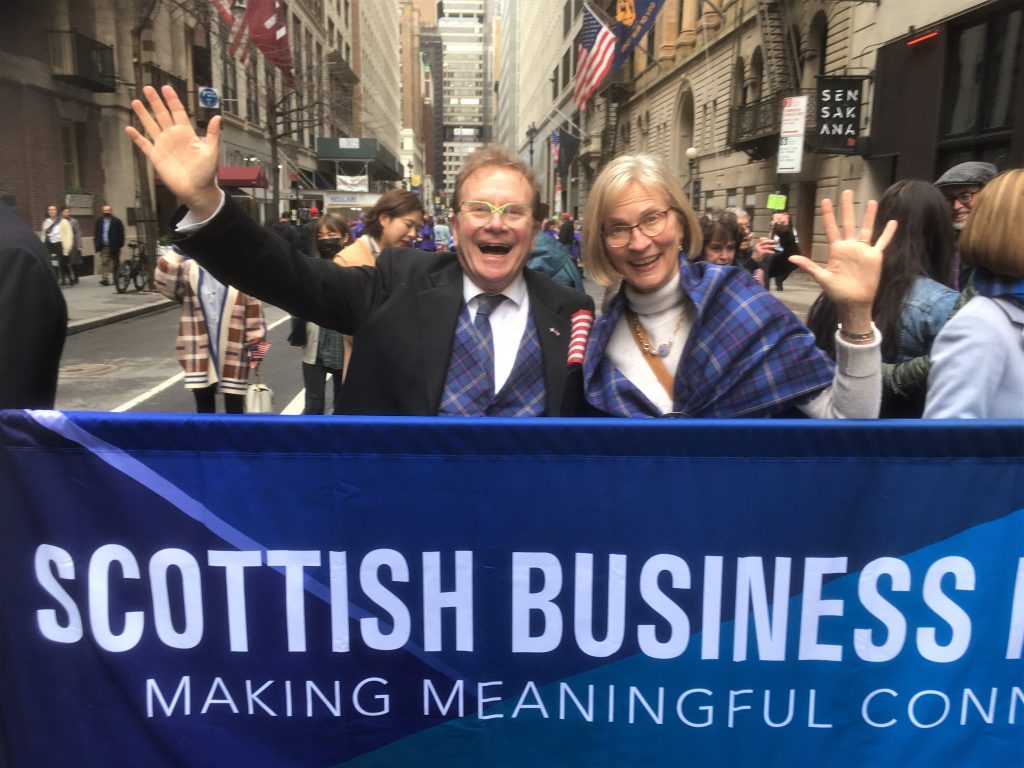
New York City Tartan Day Parade
Professor Joe Goldblatt
Professor Emeritus, Queen Margaret University
Many years ago, I had the privilege of dining with the person I believe will also eternally be fondly remembered as the Queen Mother and international champion of parades, the late Jean MacFaddin (1942 – 2018).
For nearly 25 years Jean revitalised the design of and creatively produced the world famous Macy’s Thanksgiving Day Parade in New York City. About ten years ago I asked Jean if she believed that civic and neighbourhood parades were under threat due to rising costs and competition from events such as fun runs, marathons, protest marches, and other civic events.
Almost immediately, her left eyebrow rose almost to touch the ceiling of the posh restaurant where we were dining, smoke appeared to pour forth from both of her ears, she squinted her usually wide and animated eyes and said “Nonsense! There will always be a parade!”
I wish I could ask Jean about her views today. The reason for my curiosity is recently I attended one of the many ubiquitous music festivals held every summer in Scotland and throughout the United Kingdom. These festivals range in size from the iconic Glastonbury Festival in England to small village galas (annual fetes) in Scotland.
The event I attended was celebrating a special significant anniversary and decided to mark this milestone by hosting a parade on the closing day of the event. The parade would take place upon the main street of the town that was part of a community of 20,000 citizens.
The usual reason for postponing or cancelling a parade is weather as evidenced by the cancellation of the USA Fourth of July Parade in Washington DC due to the extreme heat wave. However, in the small town where I was looking forward to the attending parade I heard a brief announcement on the radio programme that promotes local events.
“We are sorry to announce that today’s parade has been cancelled and postponed to next year due to non – participation.”
I was shocked. This event had been planned for many months in advance. I immediately tried to analyse why this historic parade would be cancelled on such short notice without severe weather conditions.
Upon interviewing local residents some believed that the lack of participation was due to the timing of the parade at the same time as the end of the school term which may have limited engagement by students. Others simply shrugged their shoulders and confidentially told me “It is a sign of the times. People do not participate the same way they did many years ago.”
I decided to investigate further and my research revealed that the decreased participation in neighbourhood parades is a global phenomenon and threat to civic cohesion.
According to the Independent Commission on Neighbourhoods (ICON) February 2026 report, in the United Kingdom, “Parades are an anchoring site supporting local capital development in neighbourhoods: they carry out civic and social roles that distinguish them from town centres as crucial hyperlocal hubs. However, the core social function we see being fulfilled on the local parades of more affluent areas is unrecognizable in the most deprived areas.”
The local community where my parade was cancelled / postponed is not categorised as a deprived area. There is 90% employment in this town and very few empty store fronts awaiting future development.
In 2025 this community conducted a major sport festival and there was significant local community involvement. Therefore, I wondered why their parade struggled the following year?
Although it remains a mystery to me as to why there was a lack of participation in this year’s parade I do believe the three macroeconomic and microeconomic issues identified by ICON may have contributed to this decision.
First and foremost, many citizens have less and less leisure time to participate in community activities. How they use this leisure time may be shifting from communal activities to individualised engagement such as personal recreational programmes to accommodate flexible schedules.
Second, the global pandemic traumatised many citizens about engaging in communal events and this post traumatic stress continues to prevent or may be used to exclude communal activities with large numbers of strangers.
Third and finally, the overall costs of producing large programmes such as parades has increased exponentially in the past two decades and therefore some organisers find it is a greater cost / benefit ratio to simply cancel these larger events in order to reduce their overall operating budget and minimise risk.
If the Queen Mother of Parades was able to advise me today about how to protect and in fact grow future parades including those in economically deprived areas I have no doubt that she would strongly advocate three strategies.
She would insist that all parades need to be continually refreshed, reinvented, and revitalised to insure they are relevant to the local residents they wish to engage. One example of this is the rapid growth of LGTBQ+ Pride parades throughout the world and another are the increased participation in ethnic and national patriotic parades.
She would also remind parade organisers and their elected officials of the social, cultural, economic, and health benefits of parades and encourage more studies to be collected to support the evidence of their positive impacts within local communities.
Finally, she would remind all of us, from elected officials the those who walk in step within a marching band, that the mental health benefits of the joy of a parade in a local community whilst often immeasurable are in fact essential to creating and maintaining more cohesive, tolerant, empathetic, and collaborative communities.
I hope that the next time someone thinks of cancelling or postponing a parade they will pause and consider the strategies one of the world’s greatest parade champions might have employed rather than silencing the joyful noises coming from the high street at a time when we need them more than ever.
Professor Joe Goldblatt is Emeritus Professor of Planned Events at Queen Margaret University in Edinburgh, Scotland.
His views are his own. For more information about his views visit www.joegoldblatt.scot
Sources
Independent Commission on Neighbourhoods (ICON) February 2026, viewed July 2026: https://www.neighbourhoodscommission.org.uk/wp-content/uploads/2026/02/11269-ICON-Pride-in-Parades-1.pdf